
Uncategorized
Swiss Kriss Herbal Laxative: Uses, Dangers, & What to Know

Jul
Most advice about Swiss Kriss starts with the same assumption: if it's herbal, it must be gentler than a regular laxative. That's the part people need to question.
Swiss Kriss Herbal Laxative may be marketed as natural, but its bowel-moving effect comes from senna, a stimulant laxative. In other words, this isn't a mild digestive tonic. It's a product that pushes the colon to contract. That can be useful for short-term constipation, but it also means the risks are real and the "natural" label doesn't change the basic pharmacology.
Many people reach for herbal products when they want something that feels safer, softer, or more suitable for repeated use. With Swiss Kriss, that assumption can lead to poor decisions. If you use it like a tea for general wellness, you're misunderstanding what it is. If you use it for too long, you may create a bigger problem than the one you started with.
Table of Contents
- An Introduction to Swiss Kriss
- Deconstructing the Swiss Kriss Herbal Formula
- The Science of Senna How Swiss Kriss Works
- Proper Use Dosage Timing and Administration
- The Natural Myth Efficacy vs Real World Side Effects
- Critical Warnings Interactions and Discontinuation Rumors
- Safer Alternatives for Long Term Constipation Relief
An Introduction to Swiss Kriss
“Natural” is the comforting part of the sales pitch. The part that matters to your colon is different.
Swiss Kriss is marketed as an herbal laxative made from plant ingredients, which leads many shoppers to place it in the same mental category as everyday wellness products. That is a mistake. From a clinical standpoint, Swiss Kriss belongs in the stimulant laxative category. In plain terms, it is closer to a drug effect than to a gentle food-like remedy.
That distinction matters because plant-based does not mean mild. Digitalis comes from a plant. Opium comes from a plant. Senna does too. The source is botanical, but the effect is pharmacologic.
Swiss Kriss makes more sense as an occasional rescue option for short-term constipation than as a routine “digestive support” habit. A person who uses it once in a while after travel, a change in schedule, or a brief period of constipation is making a very different choice from someone who takes it regularly because the label sounds softer than “stimulant laxative.”
A useful way to frame it is this: herbs can play very different roles in a formula, but only some of them drive the bowel movement. If you have ever looked at products sold as natural senna tea bags, the same rule applies. The name, flavor, and traditional branding are secondary. What matters first is whether senna is present and whether it is being used for its laxative action.
That does not make Swiss Kriss unsafe on its own. It means the product should be judged by its active laxative effect, its short-term role, and its limits. That point also helps explain why “gentle and natural” marketing can clash with real-world concerns about cramping, dependence on stimulant use, and why products in this category sometimes become harder to find or are discontinued unannounced.
Deconstructing the Swiss Kriss Herbal Formula
Swiss Kriss is often presented as a blended herbal remedy. Read the formula like a pharmacist, though, and the hierarchy becomes clear fast. One ingredient is there to produce the bowel movement. The others mainly shape how the product is positioned and experienced.

The Active Ingredient Driving the Laxative Effect
The ingredient that matters most is senna. Swiss Kriss has long been sold as a standardized senna product, which is the clearest sign that this is not just a loose traditional tea blend in tablet form. Standardization means the manufacturer is targeting a repeatable drug-like effect, not merely listing a plant for herbal character.
That distinction helps cut through the "gentle, natural" framing. In constipation products, the herb that is standardized is usually the herb doing the clinical work. Here, that herb is senna, and its active compounds are sennosides.
A useful comparison is natural senna tea bags. The delivery format changes, but the practical question stays the same. Is senna present for its stimulant laxative action? In Swiss Kriss, yes.
What the other herbs are likely doing
Swiss Kriss has also been marketed with a longer list of botanicals, including aromatic and traditional support herbs such as anise, caraway, peppermint, calendula, hibiscus, peach leaves, and strawberry leaves. Those ingredients can make a formula sound rounded and old-fashioned. They may also be included for flavor, aroma, or a traditional "soothing" identity.
That does not mean they drive constipation relief to the same degree as senna.
Anise, caraway, and peppermint are better known for effects people associate with digestive comfort, such as easing gas or intestinal discomfort. Calendula and hibiscus contribute more to the formula's herbal profile than to a predictable laxative result. Peach and strawberry leaves add to the traditional blend story, but they are not the reason the product works as a laxative.
The simplest way to read the label is to separate roles:
- Primary active: Senna, because it is the stimulant laxative component.
- Supporting botanicals: Herbs that may influence taste, aroma, or comfort perceptions.
- Common misunderstanding: Assuming a long herbal ingredient list means the effect is broad, mild, or evenly shared across all ingredients.
A formula can contain many plants and still behave like a single-agent laxative in real use. That is the case here.
This matters for safety. If a person treats Swiss Kriss like a gentle daily herbal tonic, the long ingredient list can create false reassurance. If they treat it like a senna-based stimulant laxative with a few supporting herbs around it, their expectations are much closer to reality.
The Science of Senna How Swiss Kriss Works
“Natural” is not the same as mild. Swiss Kriss works because senna has a real drug-like effect in the colon, and that effect is strong enough to trigger cramping, urgency, and problems with overuse if people treat it like a casual daily tonic.
Why it doesn't work immediately
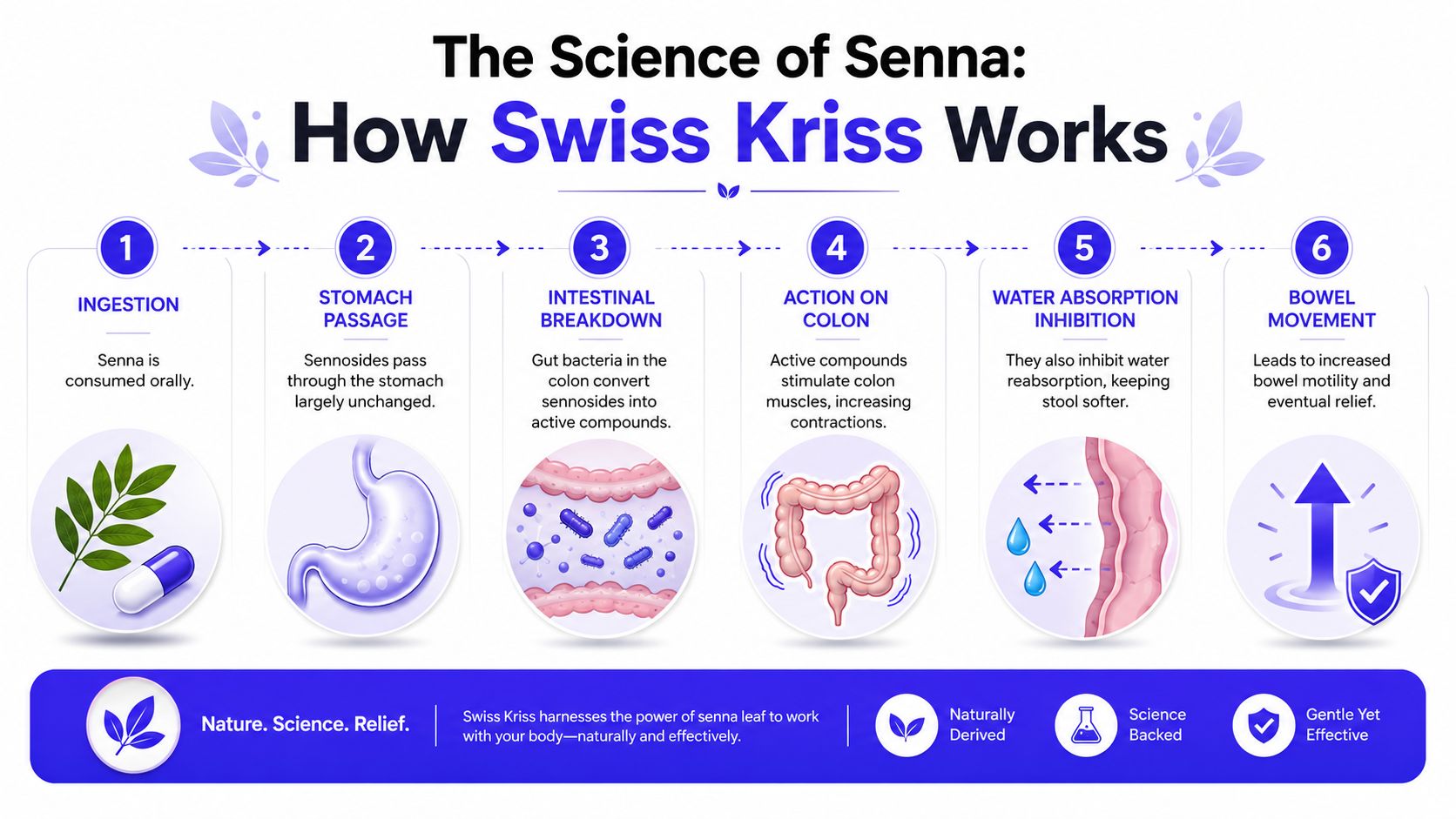
Senna does not do much in the stomach or small intestine. The active compounds in Swiss Kriss, called sennosides, pass through the upper digestive tract largely unchanged. They become active later, after intestinal bacteria in the colon convert them into compounds called rhein anthrones, according to this mechanism summary for Swiss Kriss Herbal Laxative Tabs.
That delay matters. A person takes a tablet, feels nothing for hours, and assumes the dose was too small. Then they take more. With senna, that mistake can turn a planned bowel movement into abdominal pain and repeated urgent trips to the bathroom.
A practical comparison helps here. Fiber works more like adding bulk and water to the contents of the bowel. Senna works more like pressing on the colon's activity controls after the tablet reaches the part of the gut where bacterial conversion happens.
Why it's called a stimulant laxative
The word stimulant is not marketing language. It describes the mechanism. After those active metabolites form, they increase colonic muscle activity and reduce how much water and electrolytes the colon pulls back from the stool, as noted in the same mechanism reference.
In plain terms, Swiss Kriss does two things at once:
- It makes the colon contract more strongly.
- It leaves more water in the stool.
That combination is why senna often works when gentler options have failed. It is also why the product should not be confused with a digestive comfort herb or a routine wellness supplement. The bowel movement is being provoked pharmacologically.
People often miss that distinction because the branding suggests softness and balance. The pharmacology says something more specific. Swiss Kriss behaves like a senna-based stimulant laxative, with all the usefulness and all the limits that come with that class.
That is the safety takeaway. If you understand the product as a stimulant that activates in the colon after bacterial conversion, its delayed timing and its risks make much more sense.
Proper Use Dosage Timing and Administration
The safest way to use Swiss Kriss is to treat it like a short-term stimulant medicine, not a nightly wellness habit.
Label directions for this product have generally separated dosing by age. Adults and children over 12 are typically directed to take 2 tablets once or twice daily. Children ages 6 to 11 are generally directed to take 1 tablet once or twice daily. The larger safety point is not the exact tablet count. It is the principle behind it. With stimulant laxatives, taking more does not make the bowel behave more normally. It raises the chance of cramping, urgency, and fluid loss.
Timing matters because senna does not work right after you swallow it. There is usually a delay before the colon responds. That delay is where people get into trouble. They take a dose, feel nothing for a while, then take more too soon. A better approach is to allow enough time for the first dose to declare itself before deciding it failed.
Using it at a time that gives you bathroom access the next morning is often more practical than taking it at random. The exact hour matters less than planning for the delayed effect and avoiding a day when urgent bowel activity would be hard to manage.
A simple way to frame proper use is to treat Swiss Kriss the way you would treat a fire alarm pull station. It has a clear purpose, but it is not something to use over and over as a substitute for fixing the underlying problem.
Keep these boundaries in mind:
- Follow the age-based directions on the package. Do not increase the dose because constipation feels stubborn.
- Wait for the expected delayed effect before taking more.
- Use it for short-term relief only. Product directions commonly limit use to about one week unless a clinician advises otherwise.
- Stop and get medical advice if constipation keeps returning, if you develop severe abdominal pain, or if the pattern changes suddenly.
The one-week limit deserves more respect than it usually gets. That warning is not there because the herb stops being "natural" on day eight. It is there because repeated stimulant use can train a person into a cycle of relying on bowel provocation instead of addressing diet, medications, pelvic floor issues, IBS-C, or another cause of ongoing constipation.
Two common misuses deserve a direct warning. Swiss Kriss is not a weight-loss aid, and it is not a detox tool. A bowel movement after a stimulant dose does not mean the body has been cleansed. It means the colon was pushed to contract.
If you need this kind of product regularly, the key question is no longer how to time the dose. The key question is why constipation has become frequent enough to need a stimulant at all.
The Natural Myth Efficacy vs Real World Side Effects
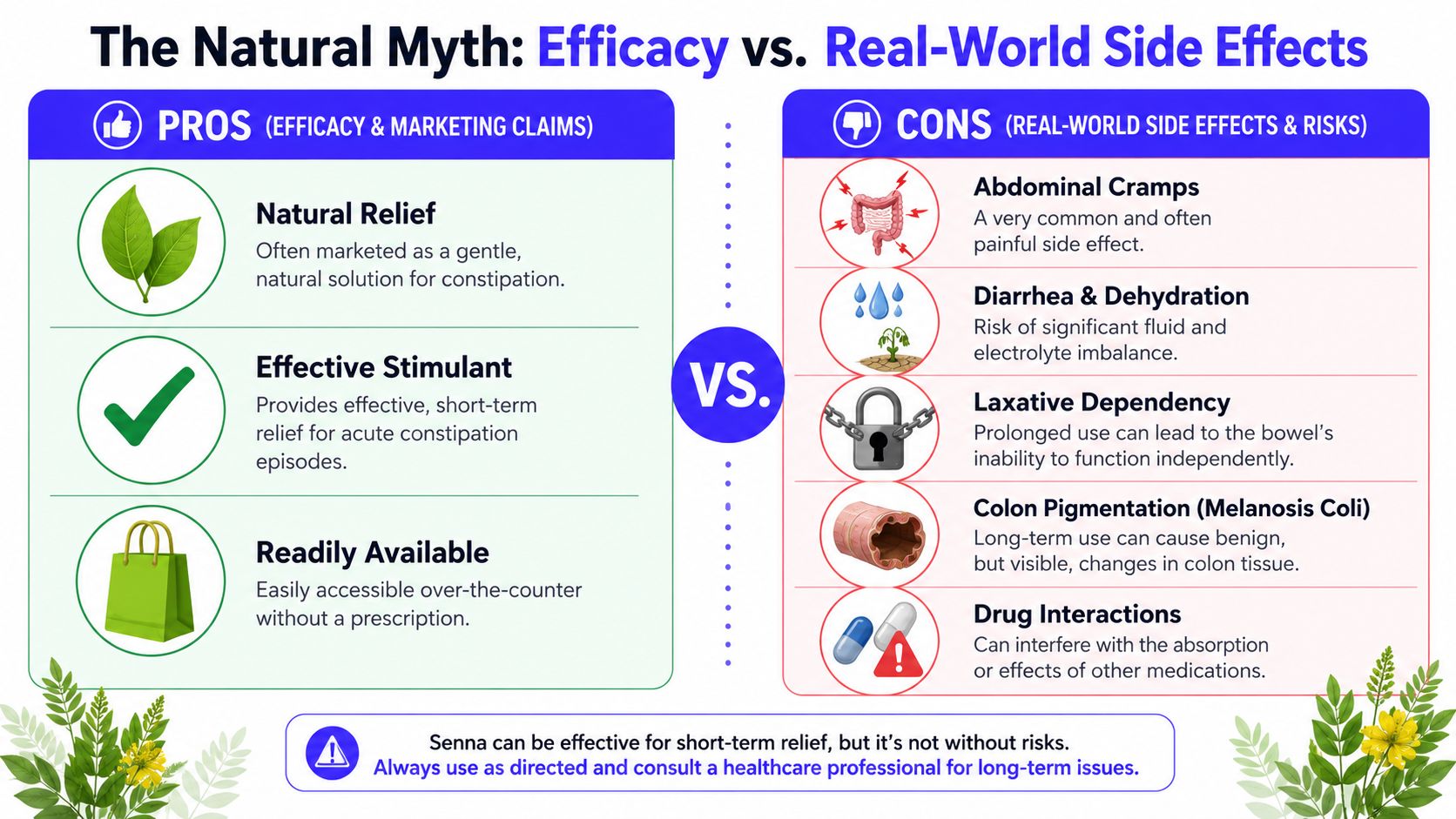
The strongest marketing claim around Swiss Kriss is also the most misleading one. It suggests that a natural senna formula is somehow softer on the body than a plain stimulant laxative. The evidence provided in the safety discussion doesn't support that.
What the marketing suggests
People often buy Swiss Kriss because they want something that sounds old-fashioned and gentle. The product name, the herbal blend, and the "100% natural" framing all push that idea.
But a natural origin doesn't cancel the core mechanism. As discussed earlier, this is still a stimulant acting on the colon. From a pharmacist's perspective, the key question isn't whether the ingredient came from a plant. The key question is what it does after you swallow it.
This video offers useful background on how stimulant laxatives fit into constipation relief choices.
What users need to respect
A safety review from Berkeley Wellness on natural laxatives notes that consumers often assume herbal means lower risk, but Swiss Kriss has the same pharmacological mechanism as harsher stimulant options, with the same risks of cramping, electrolyte imbalance, and laxative dependence. The same review also states that long-term use of anthracene-based stimulants is linked to melanosis coli and potentially increased colorectal cancer risk, with a relative risk of 3.04 reported for colorectal cancer from anthranoid-laxative abuse.
That passage deserves careful reading. It doesn't mean every short-term user will develop severe complications. It means the product should not be mentally filed under "safe because herbal."
Here is the plain-language version of the risk profile:
| Issue | Why it matters |
|---|---|
| Cramping | The colon is being stimulated to contract, which can be uncomfortable or painful. |
| Diarrhea | Too much stimulation can move stool and fluid too aggressively. |
| Electrolyte problems | Repeated fluid loss can disturb normal body balance. |
| Dependence | Regular use can train people to rely on stimulation rather than normal bowel habits. |
| Melanosis coli | Long-term anthranoid laxative use has been linked to visible colon pigmentation changes. |
Some users get confused by the word "gentle" because they equate "works overnight" with "works smoothly." Those aren't the same thing. A product can work reliably and still be harsh in mechanism.
If a laxative causes the bowel to contract and reduces water reabsorption, side effects aren't a surprise. They're built into how it works.
That's the central myth to clear up. Swiss Kriss may be effective for short-term constipation. The herbal origin of its active stimulant does not mean it is safer.
Critical Warnings Interactions and Discontinuation Rumors
People usually start asking harder questions about Swiss Kriss when they can't find it on normal retail shelves, or when they realize they've been using it more often than intended. Both situations call for caution.
Who should be especially cautious
Anyone with ongoing constipation should pause before treating themselves repeatedly with a stimulant laxative. The same goes for people who are already medically complex, taking multiple medications, or dealing with bowel symptoms that don't feel routine.
Potential interaction questions matter because stimulant laxatives can change fluid balance and bowel transit. In real life, that can complicate how a person tolerates other medicines or how well they stay hydrated. If someone is taking heart medicines, fluid-altering drugs, or anything where dehydration would be risky, self-treating casually is a bad idea.
Use extra caution if any of these apply:
- Persistent symptoms: constipation that keeps coming back or changes suddenly
- Bowel disease history: inflammatory or obstructive conditions need medical guidance
- Medication burden: especially if dehydration or altered absorption could create problems
- Abdominal warning signs: severe pain, vomiting, or unexplained bleeding need evaluation, not another laxative
Ongoing constipation is a symptom, not a personality trait. If you need repeated rescue treatment, ask why.
Why the product has become harder to find
Reports have suggested that Swiss Kriss has faded from major retail shelves due to regulatory tightening and mounting adverse effect reports linked to senna and other potent laxatives, and that this reflects broader safety concerns about anthracene laxatives, including melanosis coli and gastrointestinal damage, according to this discussion of the discontinuation of Swiss Kriss.
That matters because scarcity changes behavior. When a product becomes harder to find, people often look for old stock, unfamiliar sellers, or "equivalent" replacements. That's exactly when label assumptions become risky. A buyer may think they're replacing a trusted herbal product when they're really just buying another senna stimulant under a different presentation.
The larger lesson is simple. If a product has become controversial enough that people are openly asking whether it's been discontinued, don't treat that as meaningless gossip. Treat it as a reason to review whether the product still fits your health needs at all.
Safer Alternatives for Long Term Constipation Relief
If constipation is chronic or recurring, Swiss Kriss is usually the wrong long-term tool. Rescue tools and maintenance tools are not the same thing.
Better fits for ongoing constipation
A practical comparison helps:
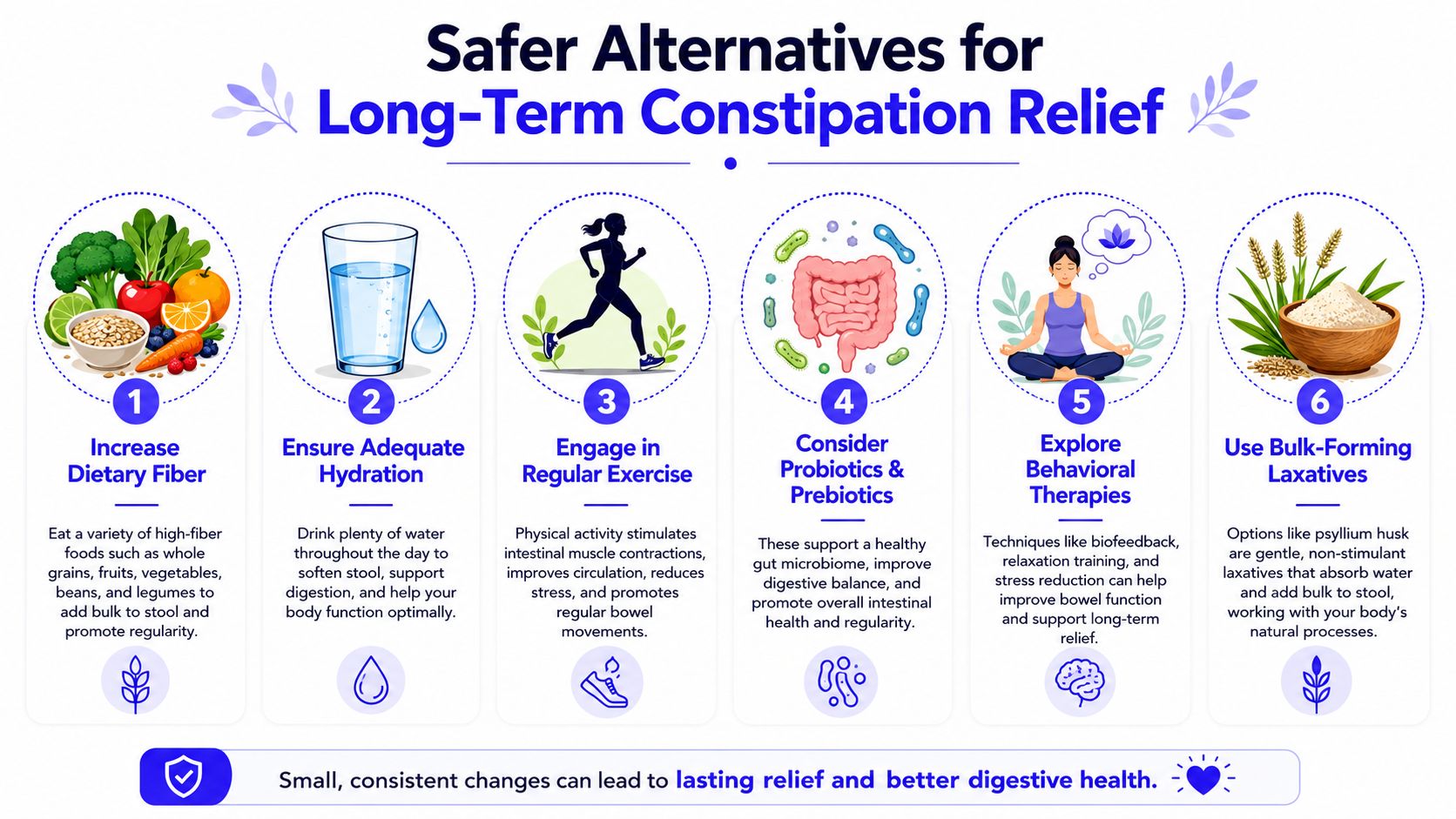
- Stimulant laxatives: These push the bowel to contract. They can be useful as short-term rescue options, but they aren't the first thing I'd choose for a long maintenance plan.
- Bulk-forming options: Products such as psyllium work more like stool builders. They support bulk and can fit better into routine management when a person also drinks enough fluid.
- Osmotic options: These help hold water in the bowel and are often considered gentler for sustained use under medical guidance.
- Non-drug basics: Food, fluid, movement, and toilet routine still matter more than many people think.
For people sorting out overlapping digestive symptoms, this overview on understanding heartburn and constipation can help connect patterns that don't always look related at first.
When to stop self-treating
The right long-term plan depends on the cause. Some people need more fiber. Some need hydration and meal consistency. Some need a medication review. Some need evaluation for a medical problem rather than another over-the-counter product.
A better maintenance mindset looks like this:
- Reduce rescue-laxative thinking. Don't build your routine around stimulants.
- Use gentler classes first when appropriate. Match the tool to the problem.
- Track the pattern. Frequency, stool consistency, pain, and diet all matter.
- Escalate when the story doesn't fit simple constipation. Especially if symptoms are persistent or changing.
The bottom line is straightforward. Swiss Kriss Herbal Laxative may help short-term constipation, but it doesn't belong in the same mental category as a harmless daily herbal support product. For ongoing constipation, safer and more sustainable options usually make more sense.
If you're exploring hard-to-find products online, Dark Net Market presents itself as a broad e-commerce catalog with category browsing, product listings, and ordering guidance. Always weigh legality, authenticity, and personal safety before using any marketplace for regulated or high-risk goods.
