
Uncategorized
Best Dark Web Markets of 2026: A Complete Guide

Jul
You're likely at a typical starting point. You've heard the names, maybe found a few onion links, maybe landed on a forum thread full of broken mirrors, fake endorsements, and arguments about which market is “safe.” That confusion is normal. The dark web doesn't reward curiosity. It punishes sloppy decisions.
If you're looking for the best dark web markets, stop thinking in terms of a magic list. Markets change, admins vanish, vendors migrate, and clones appear faster than new users can tell the difference. What matters is your process. A bad market with decent hype will still burn you. A decent market used with bad OpSec will still expose you.
The scale alone should tell you this isn't a niche sideshow. The global illicit drug trade on major darknet markets reached approximately $470 million in annual sales by 2022, and the broader dark web economy moved roughly $20–25 billion in cryptocurrency annually for all illicit goods, even after major takedowns such as Hydra's shutdown, according to DeepStrike's dark web statistics overview. That tells you two things. First, there's deep demand. Second, takedowns don't end the market. They reshuffle it.
That's why the right mindset isn't “Where do I buy?” It's “How do I reduce stupid risk?” You need to judge the platform, judge the vendors, protect your identity, and assume every step can fail.
Practical rule: If a market looks easy, clean, and convenient, get more suspicious, not less.
This guide gives you a working framework. Not hype, not recycled rankings, not fantasy about “trusted” links that stay trusted forever. Just the blunt truth about how to evaluate markets, how to tighten your OpSec, and how to avoid the traps that catch new users first.
Table of Contents
- Introduction Navigating the Modern Dark Web Landscape
- Understanding the Dark Web Market Ecosystem
- Generalist Hubs vs Specialized Boutiques
- A Framework for Evaluating Dark Web Markets
- Essential OpSec for Safe Transactions
- Notable Dark Web Markets in 2026
- Avoiding Scams Exit Scams and Honeypots
Introduction Navigating the Modern Dark Web Landscape
Most new users make the same mistake. They treat darknet markets like hidden versions of normal online shops. They compare categories, glance at reviews, and assume the platform itself is the product. It isn't. The platform is just a temporary container for risk.
That matters because the environment is dynamic. Big markets disappear, smaller ones absorb the spillover, and users chase familiar names long after those names have become bait. Some people think this constant churn means there's no point in learning the market. Wrong. It means you need a stricter filter.
A useful way to look at the modern scene is this: the dark web is less like one giant bazaar and more like a patchwork of unstable stalls, side channels, and specialist shops. Some are built for physical goods. Some are built for stolen credentials. Some are built for financial crime infrastructure. They don't all serve the same buyer, and they definitely don't carry the same risk.
What a beginner usually gets wrong
New users often focus on the wrong signals:
- Pretty design: A polished interface proves nothing.
- Big listing counts: Volume attracts scammers as well as buyers.
- Forum praise: Shills, sockpuppets, and panic posting distort everything.
- Cheap prices: Low prices often mean rushed scams or low-quality vendors.
You're not looking for a market that feels welcoming. You're looking for one that forces discipline. Security controls, consistent escrow behavior, clear communication rules, and a user base that reports problems early matter more than slick branding.
The best dark web markets aren't the ones with the loudest reputation. They're the ones that make it harder for buyers and vendors to act carelessly.
What actually helps
A market becomes usable when three things line up:
| Factor | What to check | Why it matters |
|---|---|---|
| Security posture | PGP requirements, login protections, anti-phishing habits | Weak security spills risk onto you |
| Market culture | How disputes are handled, how fast scams get exposed | Admin behavior tells you what happens when things go wrong |
| Vendor depth | Whether strong vendors exist in your category | A market can be active and still be bad for your purpose |
If you remember one thing, remember this: don't chase the market everyone's talking about. Chase the market that still looks solid after you've tried to disqualify it.
Understanding the Dark Web Market Ecosystem
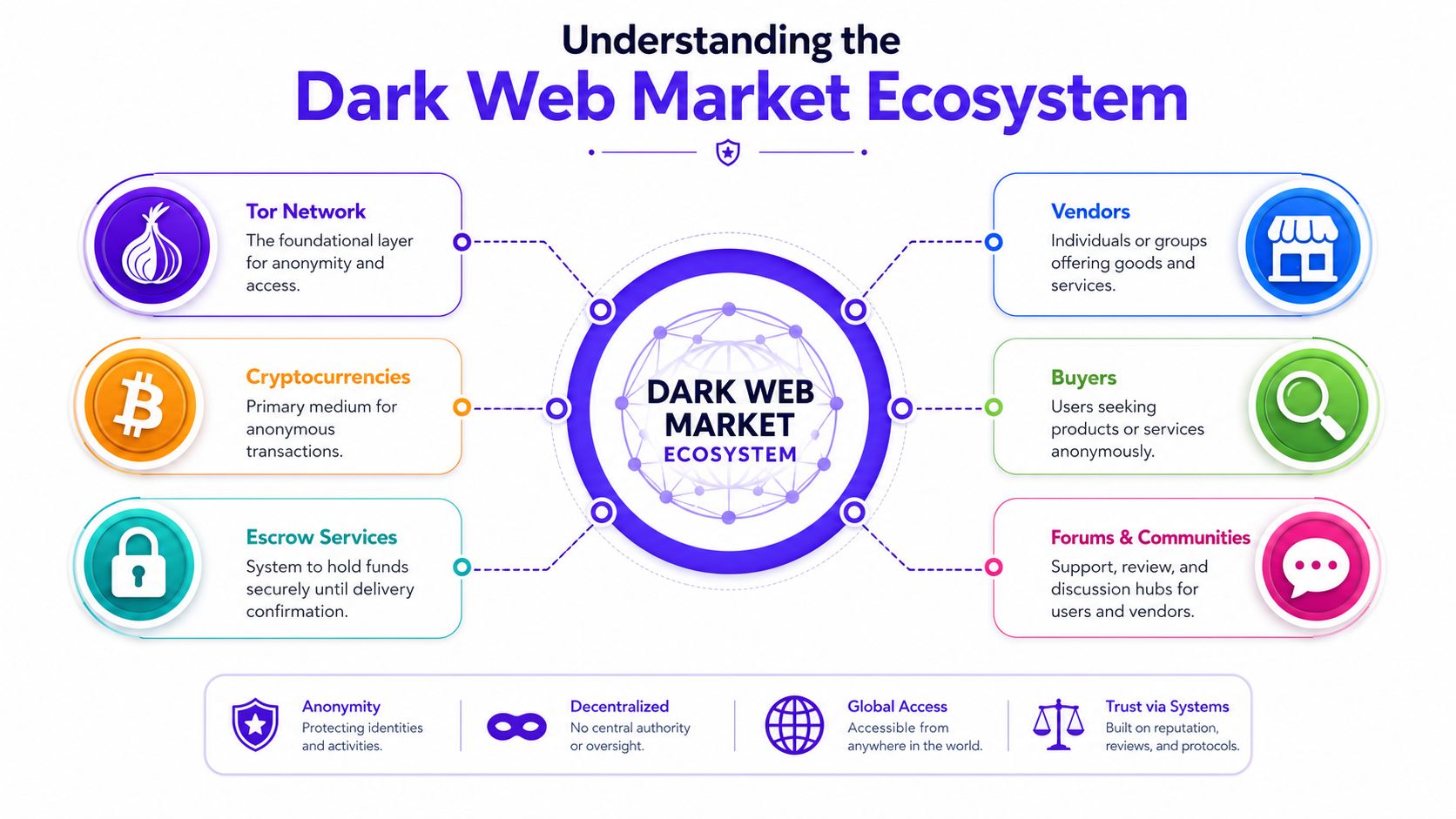
Darknet markets work like hidden digital flea markets. The setting is anonymous, the participants use aliases, and nobody has the legal system to fall back on when something breaks. That's why every working market has to build its own version of trust.
How the moving parts fit together
At the base is Tor. That's the access layer. Buyers and vendors use it to reach onion services that aren't available through standard browsers. On top of that sits the market itself, which acts as storefront, message center, escrow service, and dispute desk.
Then come the participants:
- Buyers search listings, compare vendors, and place orders.
- Vendors create listings, build reputation, and handle delivery.
- Admins run the platform, manage escrow, moderate disputes, and sometimes disappear with the money.
Around all of that sits the forum layer. Communities discuss scams, mirrors, downtime, phishing campaigns, and vendor behavior. If you ignore the forum layer, you're operating half blind.
A lot of transactions run through cryptocurrency, with Bitcoin and Monero showing up most often in market payment systems. The point isn't convenience. The point is reducing direct identity exposure compared with conventional payment rails.
Why escrow matters more than hype
Escrow is the core trust mechanism. The buyer sends funds to the market. The market holds them until the order is marked complete. In theory, that protects both sides. In practice, it creates a fragile triangle of trust where the market itself becomes the biggest single risk.
If a market has weak escrow controls, vague release rules, or pressure toward early release of funds, treat that as a structural problem. Don't shrug it off as a minor annoyance.
Here's the practical version:
- Buyer pays into escrow
- Vendor ships or delivers
- Buyer confirms
- Funds release
That's the clean version. Trouble starts when admins encourage shortcuts, vendors pressure you to finalize early, or dispute systems feel one-sided.
Escrow doesn't remove risk. It concentrates risk in the hands of the platform.
That's why market architecture matters. A market with stronger communication rules, encryption expectations, and tighter transaction controls usually gives you a better chance of spotting failure before it costs you.
Generalist Hubs vs Specialized Boutiques
You join a market because it looks busy, polished, and full of listings. Two hours later, you realize the category you care about is full of weak vendors, recycled reviews, and admins who barely police it. That mistake is common. It happens when buyers judge a market by size instead of fit.
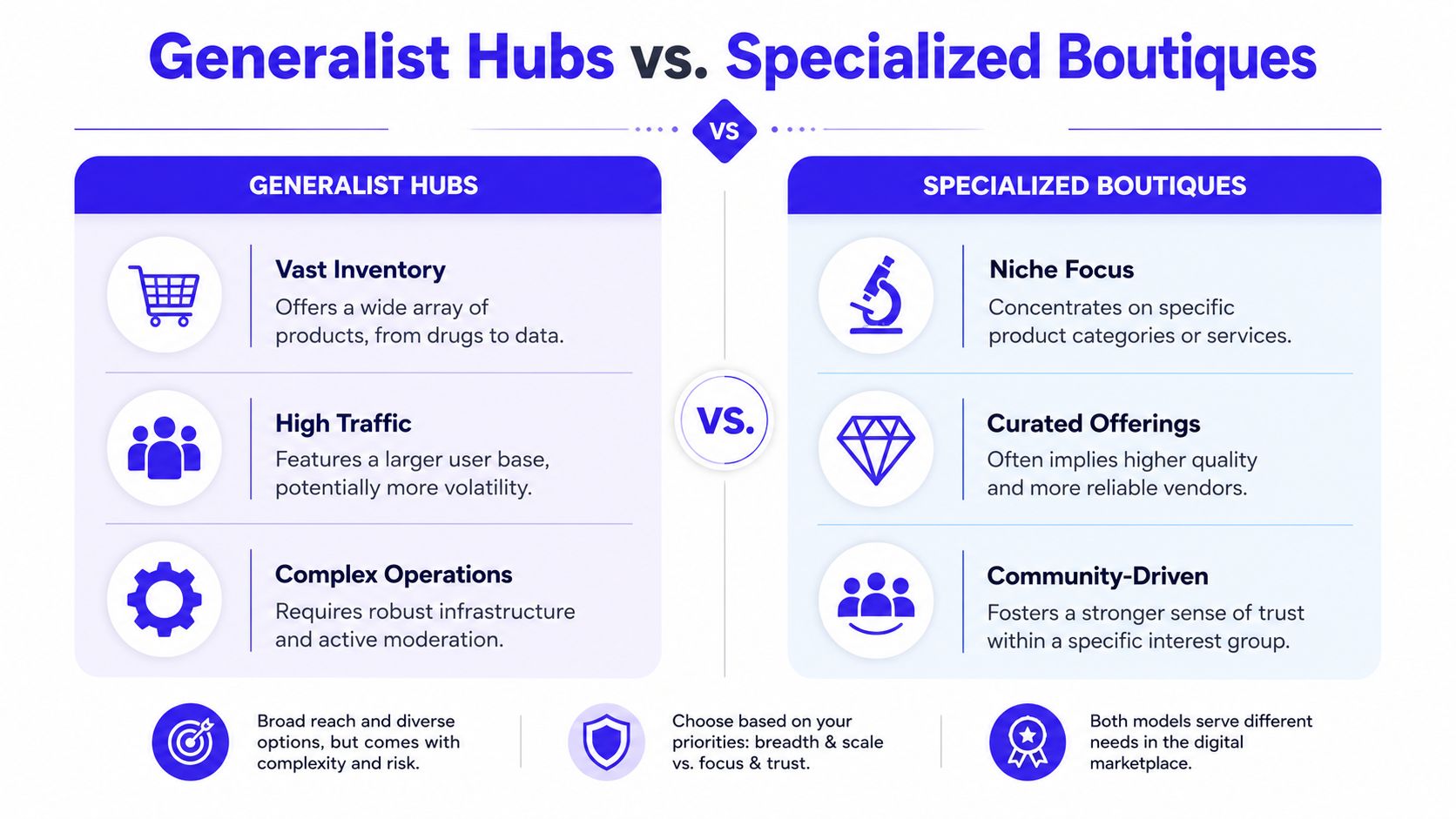
Generalist hubs and specialized boutiques solve different problems. If you treat them as interchangeable, you raise your risk for no benefit.
When generalist hubs make sense
Generalist markets win on range. You can compare multiple vendors, watch pricing across categories, and keep your activity concentrated in one place instead of spreading accounts and funds across several markets. That is useful if you are still surveying options or need access to more than one category.
The tradeoff is uneven quality. A market can look strong overall and still be sloppy in the one section you plan to use. Large inventory also creates cover for bad vendors. They hide in neglected categories, copy old listings, and survive longer because admin attention is spread thin.
Use a generalist hub if you need:
- Broad selection in more than one category
- More vendor history to compare before choosing
- Faster market reconnaissance without opening accounts everywhere
Do not use a generalist just because it is popular. Popularity attracts traffic, but it also attracts phishing clones, lazy moderation, and buyers who mistake volume for trust.
When specialized markets are the better call
Specialized markets work best when you already know your category and want tighter standards around it. The good ones build their rules, dispute handling, and vendor culture around a narrow use case. That usually makes it easier to spot who belongs there and who does not.
For example, STYX, launched in 2023, focuses on financial crime infrastructure, including stolen card data and laundering tools. It uses mandatory multisignature escrow and strong PGP requirements, which has helped it appeal to security-focused operators, according to Costas Bajjali's 2026 marketplace review.
This is a significant advantage of a boutique market. Specialization creates clearer expectations. Buyers know what good looks like in that niche, and vendors get judged by standards that match the product type.
A blunt comparison helps:
| Market type | Strength | Weakness |
|---|---|---|
| Generalist hub | Wide inventory and more vendor options | Uneven quality across categories |
| Specialized boutique | Better niche alignment and clearer standards | Limited selection and narrower utility |
The mistake to avoid is category mismatch. If a market is known for fraud tooling, do not assume its physical goods section gets the same scrutiny. If a market is strong for one digital niche, do not assume every adjacent category is safe enough to touch.
Here is the rule. Start with the market type that matches your exact use case. Choose generalist hubs for range and comparison. Choose specialized boutiques for precision and tighter category discipline. If you cannot explain why a market fits your category, you should not be using it.
A Framework for Evaluating Dark Web Markets
Stop asking whether a market is “trusted.” Ask whether it survives a serious attempt to reject it. That's the right frame. Every market gets tested through security, admin behavior, vendor quality, and community feedback. If it looks weak in two of those four, move on.
Market level checks
Start with the platform itself before you even look at listings.
Check the login and account protections. If a market doesn't push users toward strong authentication habits, that tells you the admins don't care enough about account takeover risk. Good markets usually make security habits hard to avoid.
Check the communication rules. PGP should be part of normal use, not an optional extra for paranoid people. If users casually post that they handle sensitive order details in plaintext, the market culture is weak.
Check how escrow is structured. The fewer shortcuts, the better. A market that normalizes early release of funds trains buyers to absorb unnecessary risk. That behavior attracts bad vendors fast.
Check how the site behaves under pressure. Frequent downtime by itself doesn't prove a scam. But unstable mirrors, login weirdness, broken wallets, and confused admin announcements together usually point to a platform you shouldn't trust with funds.
A quick checklist helps:
- Security defaults: PGP use, anti-phishing habits, sane login flow
- Escrow discipline: No casual pressure to finalize early
- Admin behavior: Clear announcements, consistent dispute handling
- Community chatter: Complaints that sound specific, not theatrical
Decision test: If you have to explain away multiple warning signs, you've already answered your own question.
Vendor level checks
A usable market can still host bad vendors. That's why vendor review comes second, not first.
Look for age, consistency, and specificity. Longstanding vendors with detailed feedback are safer than flashy new accounts with aggressive pricing. Read negative reviews before positive ones. Good reviews tell you what went right. Bad reviews tell you how the vendor fails.
Pay attention to the kind of complaints people make. “Slow shipping” is very different from “empty package,” “bait-and-switch,” or “support vanished.” Patterns matter more than one-off drama.
I'd screen vendors in this order:
Review history
Look for consistency over time, not a short burst of praise.Category fit
A vendor who excels in one section may be weak in another.Message quality
Clear, disciplined communication usually beats hype-heavy copy.Policy realism
Overpromising is a bad sign. Good vendors set boundaries.
Use forums to verify whether the vendor's reputation on-market matches what users say off-market. If those two stories don't line up, trust the harder story.
Essential OpSec for Safe Transactions
If you're sloppy, no market can save you. OpSec isn't decoration. It's the part that keeps one mistake from turning into a chain of mistakes.
Your non negotiable setup
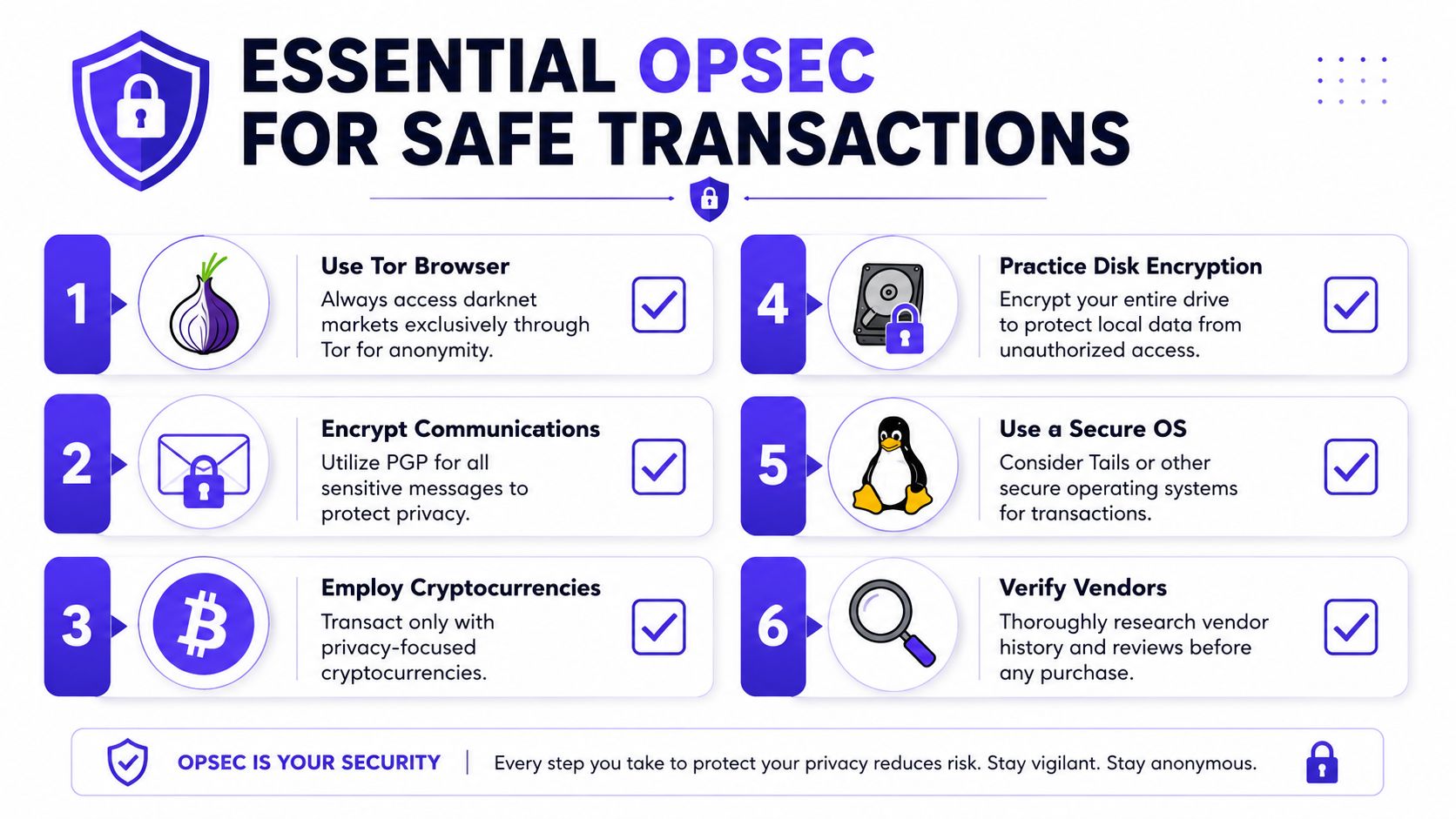
Use Tor Browser for market access. That's baseline. Don't improvise with random browsers, don't treat privacy extensions as a substitute, and don't mix normal browsing habits with darknet access.
Layering matters too. Some users add a VPN before Tor to reduce exposure from their local network or ISP. If you need help understanding what a safer VPN setup looks like, especially if you're dealing with restrictive network environments, Throughwire's guide to reliable China VPN solutions is a useful practical reference.
Your device setup matters just as much as your connection path. Encrypt your disk. Use a separate environment for sensitive activity. Many careful users prefer security-focused operating systems such as Tails because they reduce local traces and force cleaner habits.
The bare minimum setup should include:
- Tor Browser only: No casual shortcuts
- Disk encryption: Protects local data if the device is accessed
- Separate environment: Don't mix personal and darknet activity
- Unique credentials: Every market gets its own password
Here's a useful walkthrough before you go further:
Transaction habits that keep you out of trouble
Use PGP for sensitive communication. If a market supports it and you still send plaintext details, you're creating your own vulnerability. Learn the basics and use them every time. Not sometimes. Every time.
On payments, privacy-focused users usually prefer Monero over Bitcoin because Bitcoin's transaction history is far more exposed to analysis. If a market accepts both, think carefully before choosing the more transparent option just because it feels familiar.
Then there's behavior. Behavior ruins more users than technology does.
- Don't reuse names or handles from any other platform.
- Don't save market details in casual notes, screenshots, or cloud accounts.
- Don't rush deposits just because a listing looks scarce.
- Don't discuss orders outside market systems unless there's a strong reason and you know what you're doing.
Use boring routines. The dramatic failure usually starts with a tiny convenience decision.
Vendor verification belongs in OpSec too. A careless buyer who skips vendor review isn't “taking a chance.” They're volunteering to be the easy target.
Notable Dark Web Markets in 2026
If you want names, use them as case studies, not endorsements. The best dark web markets aren't “best” in the normal consumer sense. They're just the markets that currently hold a stronger position inside a volatile ecosystem.
TorZon as the current generalist reference point
TorZon is the main general-purpose example worth understanding right now. In 2026, it emerged as the leading general-purpose darknet marketplace for physical illicit goods after Abacus collapsed, with over 11,600 product listings and support for Bitcoin and Monero, according to Breachsense's analysis of dark web markets.
That matters because it shows how the ecosystem consolidates after a major platform disappears. Buyers still need a hub. Vendors still need traffic. A resilient second-tier platform absorbs the migration and becomes the new reference point.
TorZon's appeal is obvious. It's broad, active, and positioned as a generalist destination. But generalist status also means you have to apply the category filter discussed earlier. Don't assume every section carries the same vendor quality or admin attention.
Where specialized platforms fit
Specialized platforms matter because they often become leading forces in their own niches, even when a generalist gets more attention. Current reporting points to Russian Market and 2easy as dominant names for stolen credentials and stealer logs in the 2026 environment, while TorZon occupies the generalist slot in that same broader picture. That distinction is important because people often compare unlike things and call one “better” when it's designed for a different use case.
A practical way to think about notable markets:
| Market | Best understood as | Main caution |
|---|---|---|
| TorZon | General-purpose hub for physical goods and mixed categories | Category quality may vary |
| Russian Market | Specialist environment for stolen credentials | Not a general buyer's market |
| 2easy | Specialist stealer-log environment | Highly niche and purpose-built |
| STYX | Financial crime infrastructure specialist | Strong niche focus, limited general utility |
If you're evaluating current markets, don't just ask which one is biggest in conversation. Ask which one matches your category, has the right security posture, and hasn't started showing late-stage instability.
Avoiding Scams Exit Scams and Honeypots
You log in to a market you used last week. Your balance is still there. Deposits still work. Withdrawals suddenly fail, support stops answering, and vendors start telling buyers to pay direct. That is how people lose money. Not in some dramatic raid. In the slow, obvious decline they talked themselves into ignoring.
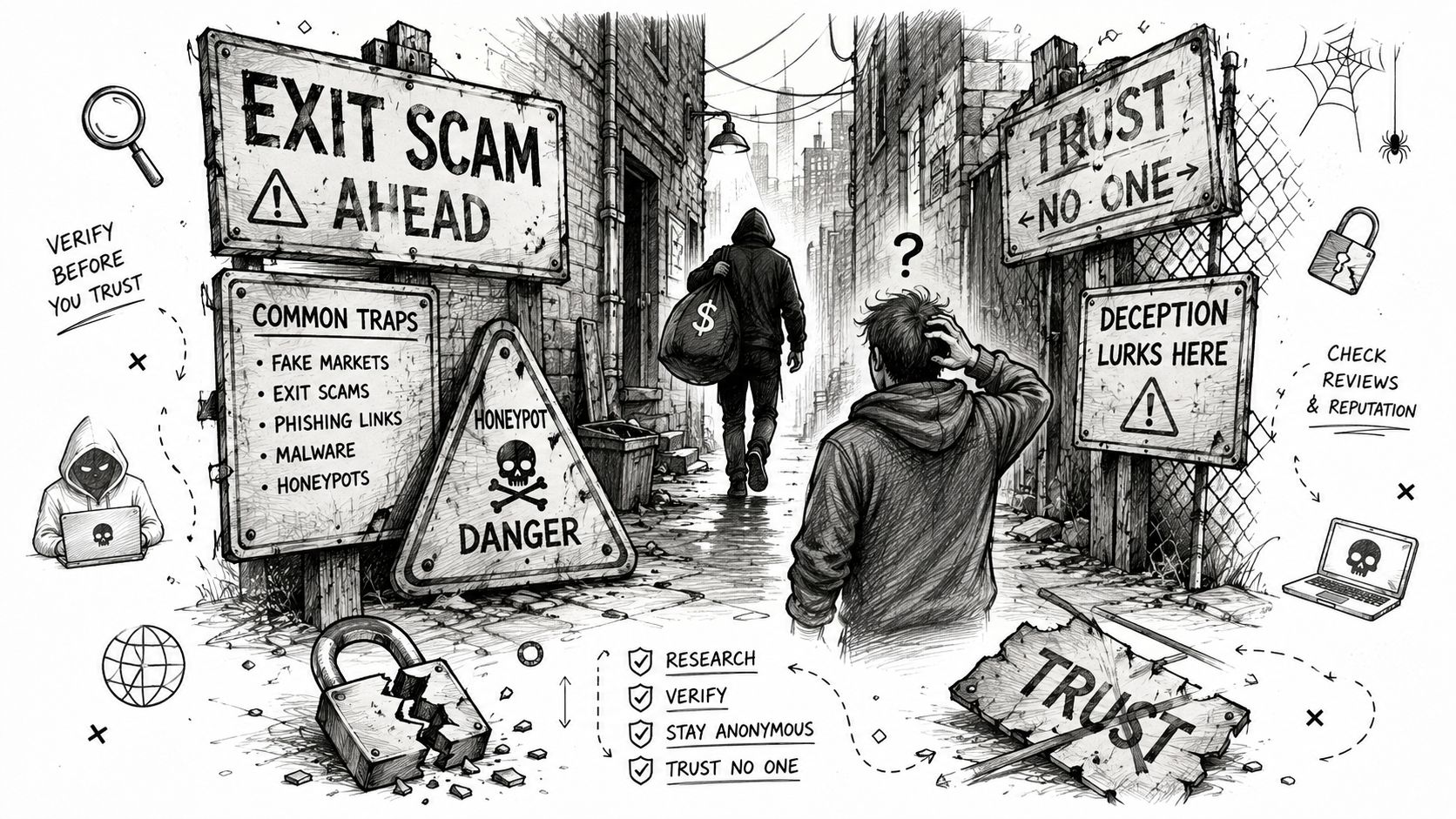
An exit scam is simple. Admins keep user funds, vanish, and leave everyone holding worthless balances or fake escrow promises. A honeypot serves a different purpose. It exists to watch who logs in, how they behave, what credentials they reuse, and who they contact. You usually do not get certainty in real time, so stop waiting for certainty. Judge by behavior and cut exposure early.
Red flags that matter
Some signals mean you should assume the risk has already changed:
- Withdrawals fail or stall: Markets on the way out often keep deposits open and make cashing out harder.
- Admin messages turn vague: Real operators communicate clearly during outages. Scammers buy time.
- Vendors push direct deals: That move strips away escrow and gives you no recovery path.
- Mirror chaos gets worse: Multiple "official" links, repeated phishing reports, and strange login prompts usually mean clones are spreading or control is slipping.
- Prices stop making sense: Unreal discounts are bait, especially in categories already flooded with fraud.
Market type matters here. Generalist hubs often carry sections that attract low-grade vendors, impersonators, and short-lived accounts. As noted earlier, category mismatch raises risk. A market can look active overall while one category is effectively a scam trap. Evaluate the specific section, not the homepage.
How to react when a market turns bad
Act like capital preservation is the only goal, because it is. Do not make one last deposit to "test" if things are still working. Do not leave funds sitting in a wallet because support promised a fix. And do not trust a vendor more just because they were reliable during normal conditions. Stress changes behavior fast.
Use this checklist:
- Pull funds immediately if withdrawals still work.
- Stop new orders until mirrors, login flow, and community reports line up.
- Verify every access point again through your saved process, not memory.
- Drop vendors asking for off-platform payment or changing terms mid-order.
- Rotate exposed credentials if you reused a username, password pattern, or PGP workflow anywhere else.
- Assume messages may be monitored if the market starts behaving strangely.
If you want a reminder of how ugly market-linked exposure can get, InsecureWeb's coverage of InsecureWeb's leak investigation shows the wider fallout that can follow criminal market activity.
A market does not need to disappear to become unsafe. Unpredictability is enough. Once withdrawals wobble, mirrors multiply, or admins stop speaking clearly, your decision is made. Reduce exposure, preserve your accounts, and leave.
